IN UNITATE FIDEI ON THE OCCASION OF THE 1700th ANNIVERSARY OF THE CONCILE OF NICEA
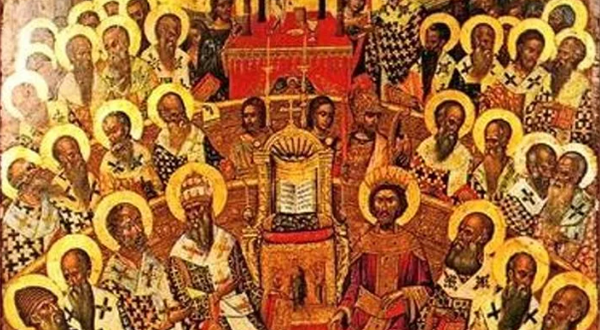
1. In the unity of faith proclaimed since the origins of the Church, Christians are called to walk together, guarding and transmitting with love and joy the gift they have received. This is expressed in the words of the Creed: “We believe in Jesus Christ, the only Son of God, who came down from heaven for our salvation”, formulated by the Council of Nicaea, the first ecumenical event in the history of Christianity, 1700 years ago.
As I prepare to make my apostolic journey to Turkey, I wish, with this Letter, to encourage throughout the Church a renewed impetus in the profession of faith, whose truth, which for centuries has been the common heritage of Christians, deserves to be confessed and deepened in an ever new and up-to-date way. In this respect, a rich document from the International Theological Commission has been approved: Jesus Christ, Son of God, Savior. The 1700th anniversary of the Ecumenical Council of Nicaea . I refer to it because it offers useful insights into the importance and relevance of the Council of Nicaea, not only theologically and ecclesially, but also culturally and socially.
2. “Beginning of the Gospel of Jesus Christ, Son of God”. This is how Saint Mark entitles his Gospel, summing up the whole of his message under the sign of the divine filiation of Jesus Christ. In the same way, the Apostle Paul knows that he is called to proclaim the Gospel of God about his Son who died and rose for us (cf. Rom 1:9), who is God’s definitive “yes” to the promises of the prophets (cf. 2 Cor 1:19-20). In Jesus Christ, the Word who was God before time and through whom all things were made – as the prologue to St John’s Gospel says – “became flesh and dwelt among us”(Jn 1:14). In Him, God became our neighbor, so that whatever we do to each of our brothers and sisters, we do to Him (cf. Mt 25:40).
It is therefore a providential coincidence that, in this Holy Year dedicated to our hope in Christ, we are also celebrating the 1700th anniversary of the first Ecumenical Council of Nicaea, which in 325 proclaimed the profession of faith in Jesus Christ, the Son of God. This is the heart of the Christian faith. Even today, in our Sunday Eucharistic celebration, we pronounce the Nicene-Constantinopolitan Creed, the profession of faith that unites all Christians. It gives us hope in the difficult times we live in, amidst the many fears and concerns, threats of war and violence, natural disasters, grave injustices and imbalances, hunger and misery suffered by millions of our brothers and sisters.
3. The times of the Council of Nicaea were no less troubled. When it opened in 325, the wounds of persecution against Christians were still raw. The Edict of Toleration of Milan (313), promulgated by the two emperors Constantine and Licinius, heralded the dawn of a new era of peace. However, disputes and conflicts quickly emerged within the Church in the wake of external threats.
Arius, a priest from Alexandria in Egypt, taught that Jesus was not really the Son of God, although he was not a mere creature; he would be an intermediary being between the inaccessible God and us. Moreover, there would have been a time when the Son “was not”. This corresponded to the widespread mentality of the time, and therefore seemed plausible.
But God never abandons his Church, always raising up courageous men and women, witnesses to the faith and shepherds who guide his people and show them the way of the Gospel. Bishop Alexander of Alexandria realized that Arius’ teachings were not at all in line with Holy Scripture. Since Arius was not conciliatory, Alexander summoned the bishops of Egypt and Libya to a synod, which condemned Arius’ teaching; he then sent a letter to the other Eastern bishops, informing them in detail. In the West, Bishop Osio of Cordoba, Spain, who had already shown himself a fervent confessor of the faith during the persecution under Emperor Maximian and enjoyed the confidence of the Bishop of Rome, Pope Sylvester, rallied to his cause.
But Arius’ followers also rallied. This led to one of the greatest crises in the history of the Church in the first millennium. The reason for the dispute was no minor detail. It concerned the very heart of the Christian faith, the answer to the decisive question Jesus had put to his disciples in Caesarea Philippi: “But who am I for you?”(Mt 16:15).
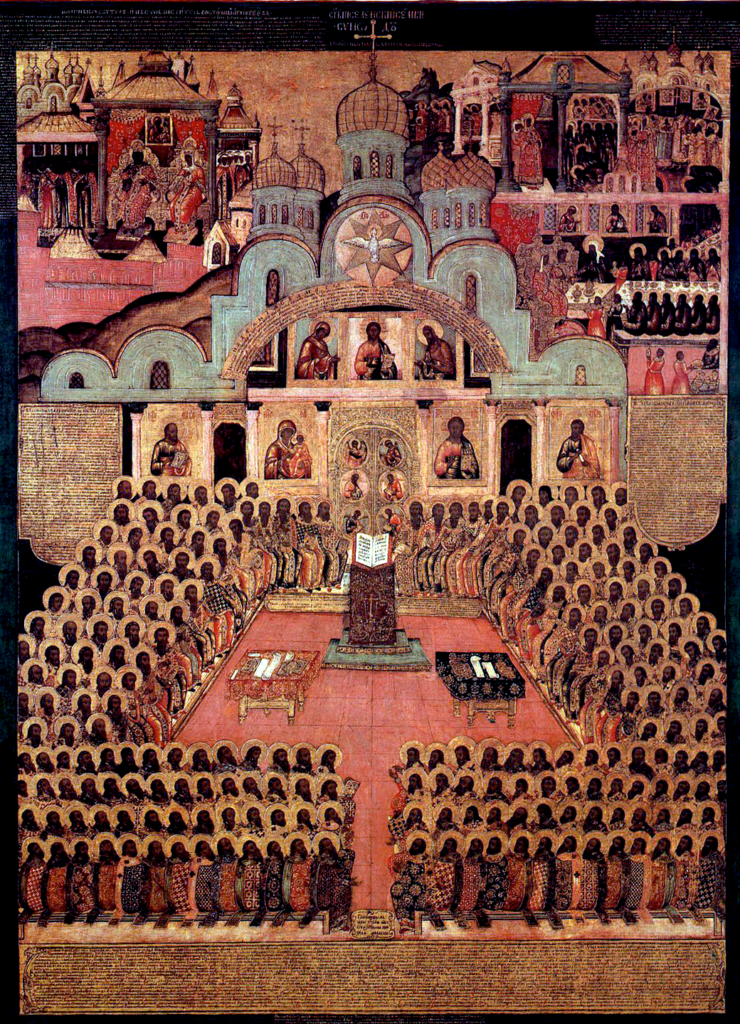
4. As the controversy raged, Emperor Constantine realized that the unity of the Empire was being threatened along with the unity of the Church. He therefore summoned all the bishops to an ecumenical, i.e. universal, council at Nicaea, in order to restore unity. The synod, called “of the 318 Fathers”, took place under the presidency of the emperor. The number of bishops gathered was unprecedented. Some of them still bore the scars of torture suffered during the persecution. The vast majority came from the East, although it seems that only five were from the West. Pope Sylvester confided in the theologically influential Bishop Osio of Cordoba, and sent two Roman priests.
5. The Council Fathers testified to their fidelity to Sacred Scripture and Apostolic Tradition, as professed in baptism according to Jesus’ mandate: “Go therefore and make disciples of all nations, baptizing them in the name of the Father and of the Son and of the Holy Spirit” ( Mt 28:19). In the West, several formulas existed, including the Apostles’ Creed. [ 1] In the East, too, there were numerous baptismal professions, similar in structure. These were not learned, complicated languages, but rather – as we would later say – simple ones, understandable to the fishermen of the Sea of Galilee.
On this basis, the Nicene Creed began: “We believe in one God, the Father Almighty, Creator of all visible and invisible beings. [ 2] The Council Fathers thus expressed their faith in the one and only God. There was no controversy on this subject at the Council. Instead, a second article was discussed, which also uses the language of the Bible to profess faith in ” one Lord, Jesus Christ, Son of God”. The debate arose from the need to answer the question raised by Arius as to how the expression “Son of God” was to be understood, and how it could be reconciled with biblical monotheism. The Council was therefore called upon to define the correct meaning of faith in Jesus as “the Son of God”.
The Fathers confessed that Jesus is the Son of God insofar as he is ” of the substance (ousia) of the Father […] begotten, not created, of the same substance ( homooúsios) as the Father”. This definition radically rejected Arius’ thesis. [ 3] To express the truth of the faith, the Council used two words, “substance” ( ousia) and “of the same substance” ( homooúsios), which are not found in Scripture. In so doing, it did not intend to replace biblical affirmations with Greek philosophy. On the contrary, the Council used these terms to clearly affirm the biblical faith, distinguishing it from the Hellenizing error of Arius. The charge of Hellenization therefore applies not to the Nicene Fathers, but to the false doctrine of Arius and his followers.
In a positive sense, the Nicene Fathers wanted to remain firmly faithful to biblical monotheism and the realism of the Incarnation. They wanted to reaffirm that the one true God is not far from us, inaccessible, but on the contrary that he has come close to us and met us in Jesus Christ.
6. To express its message in the simple language of the Bible and the liturgy familiar to all God’s people, the Council takes up certain formulations from the baptismal profession: “God from God, light from light, true God from true God”. The Council then takes up the biblical metaphor of light: “God is light”
Finally, the Creed affirms that the Son is “true God from true God”. In several places, the Bible distinguishes between dead idols and the true and living God. The true God is the God who speaks and acts in salvation history: the God of Abraham, Isaac and Jacob, who revealed himself to Moses in the burning bush (cf. Ex 3:14), the God who sees the misery of the people, hears their cry, guides them and accompanies them through the desert with the pillar of fire (cf. Ex 13:21), speaks to them with a thundering voice (cf. Deut 5:26) and has compassion on them (cf. Hos 11:8-9). The Christian is thus called to convert from dead idols to the living and true God (cf. Acts 12:25; 1 Thess 1:9). It was in this sense that Simon Peter confessed in Caesarea Philippi: “You are the Christ, the Son of the living God”(Mt 16:16).
7. The Nicene Creed is not a philosophical theory. It professes faith in the God who redeemed us through Jesus Christ. He is the living God: He wants us to have life, and to have it abundantly (cf. Jn 10:10). This is why the Creed continues with the words of the baptismal profession: the Son of God who “for us men and for our salvation came down, became incarnate and man, died, rose again on the third day, ascended into heaven and will come to judge the living and the dead”. This clearly shows that the Council’s Christological affirmations are part of the history of salvation between God and his creatures.
Saint Athanasius, who took part in the Council as a deacon of Bishop Alexander and succeeded him in the see of Alexandria in Egypt, repeatedly and forcefully emphasized the soteriological dimension expressed by the Nicene Creed. He wrote that the Son, who came down from heaven, “made us sons of the Father, and, becoming man Himself, He deified mankind. He did not become God from the man He was, but from the God He was, He became man in order to divinize us”. [ 4] This is only possible if the Son is truly God: no mortal being can overcome death and save us; only God can do that. It is He who has set us free in His Son made man, so that we may be free (cf. Gal 5:1).
In the Nicene Creed, the verb ” descended” should be emphasized. St. Paul describes this movement in powerful terms: “[Christ] annihilated himself, taking the form of a slave and becoming like men”(Phil 2:7). As the prologue to Saint John’s Gospel states, “the Word became flesh and dwelt among us”(Jn 1:14). That’s why, teaches the Letter to the Hebrews, “we do not have a High Priest who is powerless to sympathize with our weaknesses, He who was tested in all things in the same way, except for sin”
It is precisely by virtue of his incarnation that we encounter the Lord in our brothers and sisters in need: “Inasmuch as you did it to one of the least of these my brethren, you did it to me”(Mt 25:40). The Nicene Creed, then, does not speak of a distant, inaccessible, immobile God who rests in himself, but of a God close to us, who accompanies us as we walk along the paths of the world and in the darkest places of the earth. His immensity manifests itself in the fact that He makes Himself small, that He strips Himself of His infinite majesty to become our neighbor in the little ones and the poor. This fact revolutionizes pagan and philosophical conceptions of God.
Another word in the Nicene Creed is particularly revealing for us today. The biblical affirmation, “he took flesh”, is clarified by the addition of the word “man” after the word “incarnate”. Nicaea thus distances itself from the false doctrine that the Logos took on a body merely as an external envelope, but did not take on the human soul endowed with intelligence and free will. On the contrary, he wanted to affirm what the Council of Chalcedon (451) would explicitly declare: in Christ, God took and redeemed the whole human being, with body and soul. The Son of God became man,” explains St. Athanasius, “so that we men might be divinized. [ 5] This luminous understanding of divine Revelation had been prepared by Saint Irenaeus of Lyons and Origen, and then developed with great richness in Eastern spirituality.
Divinization has nothing to do with man’s self-deification. On the contrary, divinization preserves us from the primordial temptation to want to be like God (cf. Gen 3:5). What Christ is by nature, we become by grace. Through the work of redemption, God has not only restored our human dignity as the image of God, but the One who created us in such a marvellous way has made us partakers, in an even more admirable way, of his divine nature (cf. 2 Pet 1:4).
Divinization is therefore true humanization. This is why human existence aims beyond itself, seeks beyond itself, desires beyond itself, and is restless as long as it does not rest in God: [6] Deus enim solus satiat, God alone satisfies man! [ 7] Only God, in his infinity, can satisfy the infinite desire of the human heart; this is why the Son of God wanted to become our brother and our redeemer.
8. We have said that Nicaea clearly rejected the teachings of Arius. But Arius and his followers were not defeated. Emperor Constantine himself and his successors increasingly sided with the Arians. The term
The rock of the Nicene creed was Saint Athanasius, steadfast in his faith. Although he was deposed and expelled five times from the episcopal see of Alexandria, he returned each time as bishop. Even in exile, he continued to guide God’s people through his writings and letters. Like Moses, Athanasius could not enter the promised land of ecclesial peace. This grace would be reserved for a new generation, known as the “Young Nicene”: in the East, the three Cappadocian Fathers, Saint Basil of Caesarea (c. 330-379), nicknamed “the Great”, his brother Saint Gregory of Nyssa (335-394) and Basil’s greatest friend, Saint Gregory of Nazianzus (329/30-390). In the West, Saint Hilaire of Poitiers (c. 315-367) and his disciple Saint Martin of Tours (c. 316-397) played an important role. Then, above all, Saint Ambrose of Milan (333-397) and Saint Augustine of Hippo (354-430).
The merit of the three Cappadocians, in particular, was to complete the formulation of the Nicene Creed, showing that the Unity and Trinity of God are in no way contradictory. It was in this context that the article of faith on the Holy Spirit was formulated at the First Council of Constantinople in 381. The Creed, which has since been called Niceo-Constantinople, reads: “We believe in the Holy Spirit, who is Lord and giver of life, and who proceeds from the Father. Together with the Father and the Son, he is adored and glorified, and has spoken through the prophets”. [10]
Since the Council of Chalcedon in 451, the Council of Constantinople has been recognized as ecumenical, and the Nicene-Constantinopolitan Creed has been declared universally binding. [ 11] It thus constituted a bond of unity between East and West. In the 16th century, the ecclesial communities that emerged from the Reformation also retained it. The Nicene-Constantinopolitan Creed is thus the common profession of all Christian traditions.
9. The path from Sacred Scripture to the Nicene profession of faith, then to its reception by Constantinople and Chalcedon, and on into the 16th and 21st centuries, was long and linear. All of us, disciples of Jesus Christ, “in the name of the Father, and of the Son, and of the Holy Spirit”, are baptized, make the sign of the cross and are blessed. In the Liturgy of the Hours, we end each psalm with “Glory be to the Father, and to the Son, and to the Holy Spirit”. The liturgy and the Christian life are thus firmly rooted in the Nicene-Constantinopolitan Creed: what we say with our mouths must come from the heart, to be witnessed in life. So we need to ask ourselves: what is our inner reception of the Creed today? Do we feel that it is relevant to our present situation? Do we understand and live what we say every Sunday, and what does it mean for our lives?
10. The Nicene Creed begins by professing faith in God, the Almighty, Creator of heaven and earth. Today, for many people, God and the question of God have almost no meaning in life. The Second Vatican Council emphasized that Christians are at least partly responsible for this situation, for they fail to bear witness to the true faith and hide the true face of God with lifestyles and actions far removed from the Gospel. [ 12] Wars have been fought, people have been killed, persecuted and discriminated against in the name of God. Instead of proclaiming a merciful God, we have heard of a vengeful God who inspires terror and punishes.
The Nicene Creed invites us to examine our conscience. What does God mean to me, and how do I testify to my faith in Him? Is the one and only God truly the Lord of life, or are idols more important than God and His commandments? Is God for me the living God, close to me in every situation, the Father to whom I turn with filial trust? Is He the Creator to whom I owe everything I am and have, the One whose traces I can find in every creature? Am I willing to share the earth’s goods, which belong to all, fairly and equitably? How do I treat creation, which is the work of His hands? Do I use it with reverence and gratitude, or do I exploit and destroy it, instead of preserving and cultivating it as the common home of mankind? [13]
11. At the heart of the Nicene-Constantinopolitan Creed is the profession of faith in Jesus Christ, our Lord and God. This is the heart of our Christian life. This is why we commit ourselves to following Jesus as Master, companion, brother and friend. But the Nicene Creed asks more: it reminds us not to forget that Jesus Christ is the Lord(Kyrios), the Son of the living God, who “for our salvation came down from heaven” and died “for us” on the cross, opening the way to new life through his resurrection and ascension.
Of course, the following of Jesus Christ is not a wide, comfortable path, but the often demanding, even painful path that always leads to life and salvation (cf. Mt 7:13-14). The Acts of the Apostles speak of the new way (cf. Acts 19, 9.23; 22, 4.14-15.22), which is Jesus Christ (cf. Jn 14, 6): following the Lord commits our steps to the way of the Cross, which, through repentance, leads us to sanctification and divinization. [14]
If God loves us with all his being, then we must also love one another. We cannot love God, whom we do not see, without also loving the brother and sister we do see (cf. 1 Jn 4:20). Love of God without love of neighbor is hypocrisy; radical love of neighbor, especially love of enemies without love of God, is a heroism that overwhelms and oppresses us. Following in Jesus’ footsteps, ascent to God involves descent and dedication to our brothers and sisters, especially the least, the poorest, the abandoned and marginalized. What we have done to the least of these, we have done to Christ (cf. Mt 25:31-46). In the face of disaster, war and misery, we can only bear witness to God’s mercy to those who doubt Him when they experience His mercy through us. [15]
12. Finally, the Council of Nicaea is still relevant today because of its great ecumenical value. In this respect, achieving the unity of all Christians was one of the main objectives of the last Council, Vatican II. [ 16] Exactly thirty years ago, Saint John Paul II continued and promoted the conciliar message in his encyclical Ut unum sint (May 25, 1995). So, along with the great anniversary of the first Council of Nicaea, we also celebrate the anniversary of the first ecumenical encyclical. This can be seen as a manifesto updating the ecumenical foundations laid by the Council of Nicaea.
Thanks be to God, the ecumenical movement has achieved a great deal over the last sixty years. Even if full visible unity with the Orthodox and Eastern Orthodox Churches, and with the ecclesial communities born of the Reformation, has not yet been achieved, ecumenical dialogue has led us, on the basis of the One Baptism and the Nicene-Constantinopolitan Creed, to recognize our brothers and sisters in Jesus Christ in the brothers and sisters of other Churches and ecclesial communities, and to rediscover the unique and universal community of Christ’s disciples throughout the world. Indeed, we share faith in the one and only God, Father of all men, we confess together the one Lord and true Son of God Jesus Christ and the one Holy Spirit, who inspires and impels us to full unity and common witness to the Gospel. What unites us is truly far greater than what divides us! [ 17] So, in a world divided and torn by conflict, the one universal Christian Community can be a sign of peace and an instrument of reconciliation, making a decisive contribution to a global commitment to peace. Saint John Paul II reminded us in particular of the witness of the many Christian martyrs from all the Churches and ecclesial Communities: their memory unites us and encourages us to be witnesses and peacemakers in the world.
In order to exercise this ministry credibly, we need to walk together towards unity and reconciliation among all Christians. The Nicene Creed can be the basis and benchmark for this journey. It offers us a model of true unity in legitimate diversity. Unity in the Trinity, Trinity in Unity, for unity without multiplicity is tyranny, multiplicity without unity is disintegration. The Trinitarian dynamic is not dualistic, like an exclusive
This does not mean an ecumenism of return to the state prior to the divisions, nor a mutual recognition of the current status quo of the diversity of Churches and ecclesial communities, but rather a forward-looking ecumenism of reconciliation on the path of dialogue, of exchange of our spiritual gifts and heritages. Restoring unity between Christians does not impoverish us; on the contrary, it enriches us. As was the case at Nicaea, this goal can only be achieved through a patient, long and sometimes difficult process of listening and welcoming one another. It’s a theological challenge and, even more so, a spiritual one, requiring repentance and conversion on the part of all. That’s why we need a spiritual ecumenism of prayer, praise and worship, as exemplified in the Nicene-Constantinopolitan Creed.
So let’s invoke the Holy Spirit to accompany and guide us on this journey.
Holy Spirit of God, you guide believers along the path of history.
We thank you for inspiring the Symbols of Faith, and for instilling in our hearts the joy of professing our salvation in Jesus Christ, Son of God, consubstantial with the Father. Without Him, we can do nothing.
You, eternal Spirit of God, from age to age, you rejuvenate the faith of the Church. Help us to deepen it, and always return to the essentials in order to proclaim it.
So that our witness in the world is not inert, come Holy Spirit, with your fire of grace, rekindle our faith, ignite us with hope, set us ablaze with charity.
Come, divine Comforter, you who are harmony, to unite the hearts and minds of believers. Come and give us a taste of the beauty of communion.
Come, Love of the Father and the Son, to gather us into the one flock of Christ.
Show us the paths to follow, so that by your wisdom we may become again what we are in Christ: one and the same, so that the world may believe. Amen.
From the Vatican, November 23, 2025, Solemnity of Our Lord Jesus Christ King of the Universe.
LEON PP. XIV
_______________________
[1] L.H. Westra, The Apostles’ Creed. Origin, History and Some Early Commentaries Turnhout 2002 (= Instrumenta patristica et mediaevalia, 43).
[2] Conc. Nicaea I, Expositio fidei: CC COGD 1, Turnhout 2006, 19 6-8.
[3] S. Athanasius of Alexandria, Contra arianos, I, 9, 2 (ed. Metzler, Athanasius Werke, I/1,2, Berlin – New York 1998, 117-118). From St. Athanasius’ statements in Contra Arianos I, 9, it is clear that homooúsios does not mean “of the same substance”, but “of the same substance” as the Father; it is therefore not a question of equality of substance, but of identity of substance between the Father and the Son. The Latin translation of homooúsios therefore rightly speaks of unius substantiae cum Patre.
[4] S. Athanasius of Alexandria, Contra arianos, I, 38, 7 – 39, 1: ed. Metzler, Athanasius Werke, I/1,2, 148-149.
[5] Cf. S. Athanasius of Alexandria, De incarnatione Verbi, 54, 3: SCh 199, Paris 2000, 458; id. Contra arianos, I, 39; 42; 45; II, 59ff: ed. Metzler, Athanasius Werke, I/1,2, 149; 152, 154-155 e 235ff.
[6] Cf. S. Augustine, Confessiones, I, 1: CCSL 27, Turnhout 1981, 1.
[7] S. Thomas Aquinas, In Symbolum Apostolorum, art. 12: ed. Spiazzi, Thomae Aquinatis, Opuscula theologica, II, Taurini – Romae 1954, 217.
[8] Cf. S. Basil of Caesarea, De Spiritu Sancto, 30, 76: SCh 17bis, Paris 2002 2, 520-522.
[9] S. Hilaire de Poitiers, Contra arianos seu contra Auxentium, 6: PL 10, 613. Remembering the voice of the Fathers, the learned theologian, then cardinal and now Saint and Doctor of the Church John Henry Newman (1801-1890) studied this controversy and came to the conclusion that the Nicene Creed was preserved above all by the
[10] Conc. Constantinople I, Expositio fidei: CC, Conc. Oec. Gen. Decr . 1, 57 20-24. The statement “and proceeds from the Father and the Son ( Filioque)” is not found in the Constantinople text; it was inserted into the Latin Creed by Pope Benedict VIII in 1014 and is the subject of an Orthodox-Catholic dialogue.
[11] Conc. Chalcedon, Definitio fidei: CC, Conc. Oec. Gen. Decr . 1, 137 393-138 411.
[12] Conc. Vat. II, Past. Const. Gaudium et spes19: AAS 58 (1966), 1039.
[13] Cf. Francis, Lett. enc. Laudato si’ (May 24, 2015), 67; 78; 124: AAS 107 (2015), 873-874; 878; 897.
[14] Cf. id. ap. exhort. Gaudete et exsultate (Mar. 19, 2018), 92: AAS 110 (2018), 1136.
[15] Cf. id. in Lett. enc. Fratelli tutti (Oct. 3, 2020), 67; 254: AAS 112 (2020), 992-993; 1059.
[16] Cf. Vat. II, Decr. Unitatis redintegratio1: AAS 57 (1965), 90-91.
[17] Cf. Pope John Paul II, Lett. enc. Ut unum sint (May 25 1995), 20: AAS 87 (1995), 933.