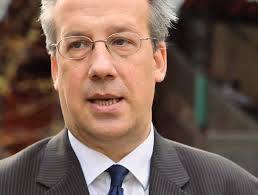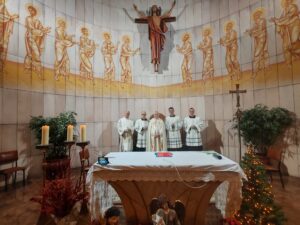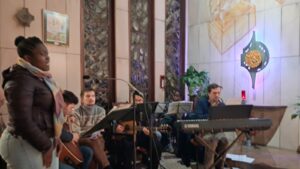
Antoine Arjakovsky, born in Paris on October 5, 1966, is a French historian, co-director of the “Politics and Religions” department at the Collège des Bernardins and director emeritus of the Institute for Ecumenical Studies in Lviv (Ukraine). Here, he offers a meditation on the Scripture passages from the ecumenical prayer celebrated in our chapel on January 23, 2026. He doesn’t hesitate to address three misconceptions about the Church and ecumenism.
—————————————————————–
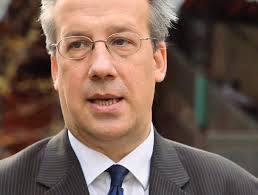
Good evening,
It’s a pleasure for me, as an Orthodox Christian who has been working on ecumenical issues for many years, to be able to share with you some thoughts on the texts we’ve heard this evening.
It’s important to come together to celebrate our faith that, as St. Paul tells the Ephesians, there is “one God, Father of all, who rules over all, works through all and dwells in all”. Christian faith in a God of love and justice transcends the denominational boundaries of our churches, for God is the Father of all and dwells in all. And above all – and this is what should drive us to act to bring about the Kingdom of God on earth – “God acts through all”. This certainly gives us an enormous responsibility to deliver this world from all its divisions and suffering, but above all it gives us immense joy: as Isaiah says, if we succeed in untying the bonds of wickedness, then our light will break forth like the dawn!
What a good idea it was for the Armenian Apostolic Church to focus our attention this evening on light! We know from Nicholas Motovilov’s 1831 account of his meeting with Saint Seraphim of Sarov that, while he was talking with him, his body began to radiate light[1], after Saint Seraphim had uttered the following prayer: “Lord, make him worthy to see clearly with his eyes of flesh the descent of the Holy Spirit, as You made Your chosen servants see when You deigned to appear in the magnificence of Your glory”. Motovilov’s story, and even more so that of Christ’s Transfiguration at Tabor, is no longer impenetrable to 21st-century man. For astro-physicists like David Elbaz: “We ourselves are machines for transforming macromolecules into heat and light. All our vital processes, as much as those of other animals, produce light. (…) Proportionally, human beings produce 2,000 times more photons than the sun. David Elbaz, Director of Research at the Commissariat à l’Energie Atomique in Saclay, adds: “For a long time, it was thought that light had nothing to do with the history of the universe, that it was only the storyteller and not the actor. And yet, from the first particle to life, passing through atoms, molecules, stars, interstellar dust and planets, the entire history of the universe and of the organization of matter, in increasingly complex forms, serves the same purpose: the multiplication of particles of light.”[2]
But then why do we see the darkness thickening around us? Everyone follows the news and understands that we are living through an extremely perilous change of era. We can all see that the Churches, and in particular the Orthodox Church to which I belong, are in deep crisis. We can all see that the ecumenical movement is running out of steam, to the point where there is growing talk of an ecumenical winter. Why is this? Well, in my opinion, it’s because we believe in 3 misconceptions about what the Church is and what ecumenism is. And the 3 texts we’ve read today help us to correct these 3 misconceptions.
The 1st misconception, professed in most ecumenical cenacles, is that the Church is like a crystal palace, in which everything should be transparent. Therefore, the sole task of the ecumenical movement is to achieve visible unity between all Christians. . But since we can’t do that, we close the doors to communion, refusing Eucharistic hospitality indiscriminately. Yet the text of the Nicene-Constantinopolitan Creed we’re going to read today explains that the world is made up of visible and invisible matter, that the Almighty Father has, from the very beginning, separated heaven and earth. As soon as the world was created, he wanted to distinguish the visible universe from the invisible one. Do we believe, little men that we are, that we can do away with this original separation? Do we think we’d live better if we could see the angels and demons all around us in a uniform, unified way? I don’t think so. Nor does the Church, since it only sets the meeting between the heavenly Jerusalem and the earthly Jerusalem for the last day. So the Church is not a crystal palace, visible to all and accessible to the first to arrive.
The prince of this world, mentioned by John in tonight’s Gospel (XII, 31-36), has been identified by Church tradition with Lucifer, the morning star fallen by pride. But to the apostles who claimed to have succeeded in subduing the demons, Christ said: “I saw Satan fall like lightning from heaven” (Luke 10:18). And the Book of Revelation, in verse 22.16, re-establishes God’s intended order: “I, Jesus, have sent my angel to testify these things to you in the churches. I am the offspring of David, the bright morning star. It is because we believe that we see. And John tells us to believe this: the true light is Christ. The important thing is to have this light with us, to believe in this light, so that each of us becomes this light ourselves!
The2nd misconception that prevents us from fully living out the unity of the Christian faith in the diversity of the Churches is to see the Church as an institution, a kind of sacred administration reserved for those with a baptismal certificate. But Saint Paul tells the Ephesians just the opposite (IV, 1-13), when he explains that the Church is first and foremost the space-time of love, of the participation of creatures in divine life. For him, the Church is the organism where only one Spirit reigns, but where many gifts flourish. In fact, when Christ ascended to heaven at the Ascension, he did not leave this world. He simply changed his condition, so as to be able to send the Spirit down to earth, and to draw everyone to himself. This is what the mystery of Ascension and Pentecost is all about. Once lifted from the earth, Christ sent the gift of tongues to all the representatives of the nations present in Jerusalem on the day of the outpouring of the Spirit. This is why Paul refers to Psalm 68, where it is said that the Lord ascended into the heights, took with him even captives, even rebels, so that God might have a dwelling place, namely the hearts of men.
Why did God have to go up to heaven to send His Spirit down to earth? In the Book of Acts, Peter gives the answer: to fulfill the promise made to the prophet Joel: “I will pour out my Spirit on all flesh”. The Church, then, is a living body in God, where all forms of vocation and calling are called to flourish. Paul gives as an example of a vocation in the Church “prophets and catechists”. But Joel says that, in reality, this outpouring of the Spirit will concern all those who have given their lives to the call received, the young who will have visions, the old who will have dreams, even slaves, men and women. So, rather than imagining the Church as a place where the sacraments are simply delivered, let’s imagine it as the space-time of a divine-human liturgy that takes place in the world, transcending all the denominational, social, political and intellectual boundaries of this world.
The3rd misconception we have, this time of the ecumenical movement, is that divisions between churches can be overcome by the scrupulous observance of a few rules, such as dialogue, prayer, solidarity and fasting. But the prophet Isaiah (LVIII, 6-11), whom exegetes call the3rd Isaiah, tells us that these methods are insufficient. For there is genuine fasting and hypocritical fasting, creative dialogue and pointless chatter. You can’t fast and argue at the same time. You can’t engage in dialogue while putting the murderer and the victim on the same level. True sacrifice is sharing bread with the hungry and sheltering the homeless. Isaiah tells us that every time we set the oppressed free, we draw closer to God, and automatically closer to one another. Every time we ease a situation or free ourselves from a yoke – today we’d say an addiction – then, Isaiah tells us, we can be sure that our wound will heal quickly. And above all, he adds this extraordinary promise. Then, “Your light will rise in the darkness, your darkness will be like noonday. The Lord will guide you always.
Dear friends, let us beware of false lights that prevent us from recognizing each other as brothers and sisters in Christ. God has placed all his hope in us to complete his creation, to make us living torches, to transform with him all darkness into knowledge, to console all suffering. The Church is not a crystal palace, where everything is visible to the first comer who has not even prepared his habit. The Church is the mystery of the Kingdom of divine humanity, which is certainly visible, but only if you have faith, an open heart and are at peace with your loved ones. Nor is the Church a bureaucratic, confessional structure, so sacralized as to be incapable of recognizing the diversity of the Spirit’s gifts. It is a space-time of life, regeneration, communion and salvation. It is certainly an institution, and that’s fine, but not in the authoritarian way of this world. The Church is both the Body of Christ and the Temple of the Holy Spirit, open to all who seek to live according to the gifts of the divine Spirit. Bishop Georges Khodr of Mont Liban wrote: “The Lord acts wherever He pleases, and you are in no position to limit His action. He has promised to fill you with His graces, but He has not said that He will make you the sole custodians of them. I implore you: don’t be more optimistic than your King, who can ‘make sons of Abraham out of stones’ (Mt.3:9)”[3].
This is why the ecumenical movement itself is not simply a place for palaver, as some would have it. It is a Church of Churches, a quest for fullness in the Spirit. Ecumenism, in the words of Pastor Wilhelm Visser’t Hooft, is a way of thinking, believing, transmitting and acting together in the Holy Spirit. The ecumenical movement that brings us together this evening is first and foremost a movement of living beings, from all horizons, in search of divine Wisdom, of the Light that never fades. This is what was proclaimed by Saint Gregory of Narek, a 10th-century Armenian mystic, and Saint Nerses the Gracious, a 12th-century Armenian ecumenical saint whose prayers we’ll be reading shortly. It’s also what Eastern and Western Christians have been singing by candlelight at nightfall for over 2,000 years, with this hymn from the Lucernaire, with which I’ll conclude, addressed to Christ as the joyful light of God’s Glory:
“Joyful light of the holy glory of the immortal, heavenly, holy and blessed Father, O Jesus Christ. Having reached sunset, seeing the evening light, we sing to God, Father, Son and Holy Spirit. It is worthy in all times to celebrate you with holy voices, O Son of God, who gives life. So the world glorifies you. Amen.
[1] “You feel that someone is clasping your shoulders with his hands, but you see neither his hands, nor his body, nor yours, but only this brilliant light that spreads several meters away all around, illuminating the snow-covered surface of the meadow, and the snow that continues to dust the great Staretz and myself.” download_ecrits_saint_seraphim_de_sarov
[2] David Elbaz, La Plus Belle Ruse de la lumière : Et si l’univers avait un sens…, Odile Jacob, 2021
[3] Mgr. Georges Khodr, “L’appel de l’Esprit” Cerf, Paris 2001, p. 7.