Welcoming Remarks at the Opening of the Eucharistic Celebration Marking the Bicentennial of the Pontifical Approval of the Congregation of the Oblates of the Virgin Mary
Dear brothers and sisters,
Dear confreres,
Dear friends,
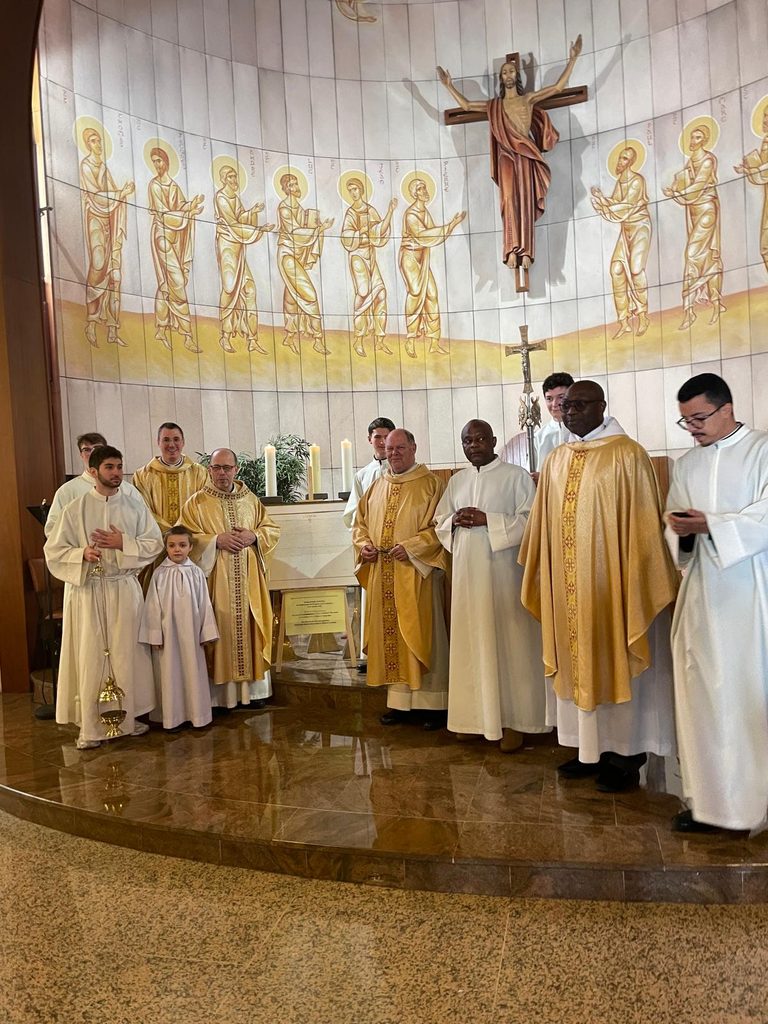
It is with deep joy and great gratitude that we are gathered here today to celebrate the bicentennial of the pontifical approval of our Congregation of the Oblates of the Virgin Mary, granted by Pope Leo XII in 1826.
Two hundred years ago, this approval officially recognized the spiritual and apostolic insight of our founder, the Venerable Father Pio Bruno Lanteri. Far more than a legal recognition, the Church was embracing a charism, discerning its authenticity, and entrusting it with a mission in the service of the people of God.
For Father Lanteri and his first companions, this approval marked the culmination of a long journey of faith, but also the beginning of a new responsibility: to make this gift from God bear fruit beyond individuals, places, and generations.
This mission, which began in the heart of Piedmont, soon spread beyond the borders of its place of origin. As early as 1835, the Oblates settled in Nice, which was then part of the Kingdom of Sardinia. More than a century later, in 1959, their presence continued in Fontenay-aux-Roses, reflecting the same fidelity to Father Lanteri’s charism and a constant willingness to serve the Church.
On this day of remembrance and thanksgiving, how can we fail to recall with emotion and gratitude all those Oblates who have gone before us? Many had left their homeland, their families, their language, and their culture to serve the Church in a land that was not their own. There they devoted their strength, their talents, their years, and very often their entire lives.
Though foreigners by birth, they were no longer foreigners at heart. They had not come to seek anything for themselves, but to give what was most precious to them: their lives, out of love for Christ and for those to whom they had been sent.
Some now rest there, far from their homeland, but very close to those they loved and served. Their example reminds us of what it means to be an Oblate: not to belong entirely to ourselves, but to consent to give of ourselves wherever the Lord calls us.
Today we owe them far more than just our remembrance: we owe them fidelity to the mission they have passed on to us.
For celebrating two hundred years of pontifical approval cannot consist solely in looking back at the past.
An approval received in 1826 remains, in 2026, a call addressed personally to each Oblate.
Being an Oblate is not merely a matter of belonging to a religious institution. It means embracing today the charism entrusted to our founder and committing to make our lives an offering to the Lord, under the watchful eye of the Virgin Mary, in service to the Church and its mission.
What are we doing with this legacy today? Do our fraternal life, our prayer, and our apostolic dedication still make Father Lanteri’s vision visible? Have we preserved the spiritual boldness that inspired our first confreres?
The challenges of our time are many: passing on the faith, providing spiritual guidance, forming consciences, and reaching out to young people and those seeking meaning in their lives. These are all calls to which our Congregation must respond with courage, discernment, and creativity.
But one essential challenge remains: that of passing on the legacy and ensuring the next generation takes up the torch. Generations come and go; communities change. Those who came before us carried the mission forward to us; it is now up to us to prepare those who will carry it on after us.
For a charism is not given to us to be preserved as a static legacy, but to be passed on as a living flame.
This continuity, however, does not depend solely on our own efforts. It is part of Providence’s plan. It is God who calls, it is God who inspires vocations, and it is God who opens paths where we least expect them.
But Providence does not exempt us from taking action. Through the joyful witness of our fraternal life, through our fidelity to our consecration, and through our apostolic readiness, we can inspire others to follow Christ in the spiritual family of Father Lanteri.
The fact that new faces, new cultures, and new generations come to enrich our Congregation will be a sign of the ever-renewed fruitfulness of this charism— both where we are already established and wherever Providence calls us to serve.
Our hope, then, does not rest primarily on the number of those who will come after us, but on the faithfulness of the One who, for two centuries, has never ceased to call. It is up to us not to let the flame we have received be extinguished; it is up to God to raise up those who, in the future, will carry it further.
That is the deeper meaning of this bicentennial: not only to give thanks for two centuries of history, but also to renew our commitment to be, today, the Oblates that the Church and the world need.
We are not merely celebrating a date or the longevity of a congregation. We are celebrating God’s faithfulness, as He continues to call, guide, and send men to serve His Gospel.
During this Eucharist, let us give thanks for Father Lanteri, for the generations of Oblates who have gone before us, for those who carried out our mission in Nice, to Fontenay-aux-Roses and elsewhere in the world, as well as for all the laypeople, friends, and benefactors who share in our spiritual and apostolic journey.
Let us ask the Lord, through the intercession of the Virgin Mary, that this bicentennial may be for each of us not only a grateful remembrance of the approval we received, but also the grace of a new missionary zeal.
May what was recognized by the Church in 1826 continue to live fully in each of us in 2026.
Let us now enter into this Eucharistic celebration with hearts that are grateful for the past, faithful in the present, and confident in the future.
Amen.